For most of the industrial age, "manning the machine" meant something specific. You stood at it. You fed it. You worked at its pace, on its schedule, and when it stopped, you stopped. The machine was the important thing. The person was there to keep it running.
That arrangement has quietly flipped.
The machines we're building now don't need feeding. They write, design, analyze, negotiate, and increasingly, they build, sometimes even the next version of themselves. Give one a goal and it will go find the steps. So the old question, whether the human can keep up with the machine, has stopped being interesting. The new one is stranger: when the machine can do the work, what is the human at the controls for?
I don't know the full answer yet. This blog is where I'm going to work it out in public.
Where I'm standing
I've been assembling things my whole life: Lego first (I still love it), then gadgets, computers, and eventually products. For years I've done that inside other people's companies, with long hours, too many roles and a lot of trial and error. I still do that most days.
What's changed is the question I bring to work. I stopped wanting to bolt new tech onto old ways of working and started trying to build things with intelligence in the DNA from day one.
I once hired a small team to help me build a digital second brain for the books I was reading, something anyone could use, with AI-powered insights on top. I remember staying up two nights in a row to get it over the line. Recently I built the same kind of thing on my own in less than an hour.
What stayed with me wasn't the time collapsing. It was that the thinking felt exactly the same: the same decisions, the same mental model, the same moments of doubt. The only difference was that no one else was in the room. The machine did the assembly. It couldn't tell me whether the result was any good. That call was still mine.
It made me rethink the work itself. Strip out the hours of assembly and what's left is the part we never had enough time for: intuition, taste, the senses, the feel of a thing. I don't want to do less. I want to feel more alive at work, and ten times more creative.
But I walked away with a question I haven't been able to shake. If the machine only gets smarter from here, how much of that will stay mine?
That experiment is still running, and it's where I'll be writing from.
The other place I'm writing from is a cinema seat. I love reading science fiction and take films more seriously than is probably healthy. That turns out to be useful. Fiction and film are where we prototype futures before we can afford to build them: the interfaces, the cities, the machines, the relationships, and the everyday interactions nobody has designed yet. Most of what's being built today was drafted first by someone with no budget and a typewriter. Movies keep handing us these ideas early; we just don't pay enough attention. So most essays here will end in The Projection Room: one film scene, and an argument with it.
What I'll be looking for
Many things that used to be impossible are about to become merely hard. Intelligence, robotics, biotech, energy, new interfaces. The line of what we can build is moving faster than our sense of what we should.
That gap is where I want to write. Not about technology on its own, but about the collisions: the novel that turns out to be a product spec, the engineering breakthrough that makes an org chart obsolete, the small product decision that quietly sets the terms for how people will live twenty years from now.
None of us are passengers in this. Every product we ship, every company we start, every story we repeat is a small vote on which future gets built. This blog is my attempt to vote out loud.
What I won't do
I won't predict. Predicting the future is a way of standing outside it, and I'd rather be inside, asking what we could build if we chose to.
And I won't cheerlead. I'm an optimist; I believe technology can give far more people agency over their own lives. But optimism that won't look at the risks isn't optimism. It's marketing. Some of these essays will end on a question I can't answer, and I'd rather leave it open than tie it off with a bow.
Why the name
Here's my first answer to that question about what's still mine. When the machine can build almost anything, the scarce thing is no longer effort. It's judgment: deciding what's worth building, for whom, and why. The person at the controls doesn't become less important as the machine gets smarter. They become almost the only part that matters.
That's the job now. Not keeping up with the machine. Manning it.
— Milos
---
The Projection Room
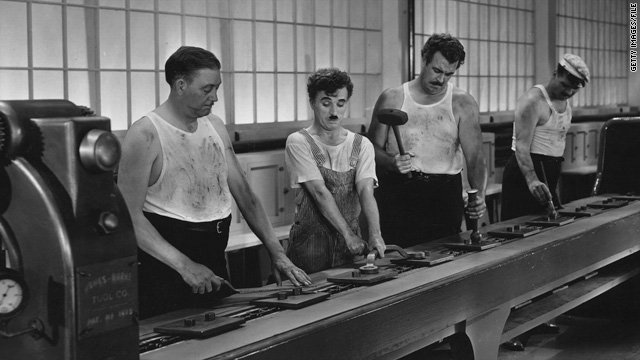
Modern Times, 1936. The president of the steel works sits in a quiet office, fiddling with a jigsaw puzzle and leafing through the comics while his secretary brings him things. Then he switches on a two-way screen and the factory floor appears. He barely looks up. "Section 5, speed 'er up."
Downstairs, Charlie Chaplin stands at the line with a wrench in each hand, tightening bolts on steel plates that never stop coming. The line speeds up. He falls behind, scrambles, catches up, falls behind again. He can't even escape in the washroom: when he sneaks a cigarette, the president's face fills a screen on the wall and orders him back to work. Eventually the speed wins. He's still twitching the wrench motion when the line stops, and before long he's dragged onto the belt and swallowed by the gears.
It's one of the funniest sequences ever filmed, and it's also a precise diagram of who held the controls. One man, with a screen, a puzzle, and all the time in the world. Hundreds of men with wrenches and none. Access to the controls was the scarcest thing in that building, and it decided who got to think and who had to keep up.
What's changing now isn't that the control room disappears. It's that it's getting cheap. A person with a few good agents has something much closer to the president's screen than to Chaplin's wrenches. So the question isn't just who gets the chair anymore. It's what we do once we're sitting in it. The president used his to speed up the line and watch people through walls. I'd like to think we can use ours to give the hours back: to the taste, the intuition, and the craft the line never had room for.