There are two kinds of transformer in AI right now, and the second one deserves more of our attention.
The first is the architecture underlying many leading language models. The second is a large piece of electrical equipment that changes voltage, helping deliver power from the grid to a data hall. For the last few years we've talked almost entirely about the first. But follow a chatbot answer backward, past the model and the GPU and the rack, and you arrive at the second. For large power transformers, procurement lead times in the United States have stretched into years.1
That's the observation this essay hangs on. The visible layer of AI is software. The limiting layer, increasingly, isn't.
The bottlenecks multiplied
For much of my working life, building software meant finding enough people who could build it together. Hiring helped, until coordination became its own problem: explaining the decisions, reviewing the work, and keeping everyone pointed at the same thing.
AI loosens some of those constraints. Models can write code, operate browsers, and carry out parts of a workflow. More compute can buy more attempts, more testing, and more work done in parallel. It doesn't automatically buy a good product. Someone still has to decide what success looks like and notice when the system is confidently doing the wrong thing.
The physical constraints are becoming harder to ignore alongside the human ones. Chips and advanced packaging. High-bandwidth memory. Grid connections. Cooling. Transformers, turbines, and electricians who can work at high voltage.
In an October 2025 interview, Microsoft's Satya Nadella described power and ready-to-use data-center space as constraints on deploying chips the company already had.2
Software didn't become less important. Its growing capabilities made the infrastructure underneath it harder to take for granted. And they made another question harder to avoid: who gets the benefits of that infrastructure, and who has to live beside it?
Intelligence becomes industrial
Here's the frame I've landed on: intelligence is becoming an industrial product.
Training and running a frontier model depend on a vast energy-and-compute system. Its electricity consumption can be measured in kilowatt-hours, its operating economics in tokens per dollar, and its energy efficiency in tokens per joule. Those measures aren't the whole story—a cheap wrong answer is still a wrong answer—but they make the physical production of machine intelligence visible.
The cost of buying a given level of capability has fallen sharply. Stanford's 2025 AI Index found that inference prices for systems matching GPT-3.5's performance on a particular benchmark fell more than 280-fold between November 2022 and October 2024.3 That doesn't mean every model or task gets cheaper at the same rate. Agents that retry, use tools, and check their work can consume much more compute than a single response.
This raises the possibility of a Jevons-style rebound: cheaper intelligence could encourage enough additional use to outweigh efficiency gains. Falling prices and rising spending alone don't prove that mechanism. Adoption, more demanding workloads, and efficiency all move at once.
The IEA's 2025 base case projected that electricity use across all data centres—not just AI—would rise from about 415 terawatt-hours in 2024 to around 945 in 2030, slightly more than Japan's electricity consumption at the time. Its scenarios for 2035 ranged from roughly 700 to more than 1,700 terawatt-hours. Those are alternative pathways, not a confidence interval: slower adoption and supply bottlenecks matter, as do efficiency improvements.4
Demand signals are real, but they aren't guarantees. In October 2025, SK hynix said it had secured customer demand for its entire planned DRAM and NAND production for 2026.5 That tells us where buyers expected pressure. It doesn't settle whether every investment being made around AI will earn its keep.
The parallel I keep returning to is electricity: a capability that becomes useful across industries, changing how work is organized. That's what I mean by the Machine Age. It begins when intelligence stops being a feature and becomes a utility.
The machine that builds machines
The next question is what happens when AI starts improving the systems used to produce and deploy AI.
There is already a concrete example. In May 2025, Google DeepMind reported that AlphaEvolve improved a matrix-multiplication operation used in Gemini training by 23%, reducing overall training time by 1%. It also reported improvements in data-center scheduling and chip design.6 These are bounded engineering gains inside human-designed processes, not a system independently inventing its successor. They're still worth paying attention to: a small improvement repeated across a large operation can matter enormously.
Manufacturing offers a useful comparison. Ford and his engineers refined the moving assembly line during 1913–1914, cutting Model T assembly time from roughly twelve and a half hours to ninety-three minutes.7 The lesson I take from that is to look beyond the thing being made and examine the process that makes it possible. Tesla has described its manufacturing systems in similar terms: the machine that builds the machine.8
Chamath Palihapitiya applies a factory analogy to software in an essay introducing his company's Software Factory product.9 I find the analogy useful, with a limit: repeating an assembly process is different from discovering what a product ought to do. Software requirements change, users surprise you, and a passing test can miss the point.
The possibility I'm watching is a production system that keeps more of the reasoning behind the work: the requirements, the failed attempts, the checks, and the decisions someone made along the way. Agents could help turn that record into faster, more reliable execution. Whether they do depends on how well people build the feedback and verification around them.
As more assembly becomes automated, power and infrastructure become harder constraints—but deciding, verifying, and coordinating the work remain human problems.
Which brings me back to the transformers.
The atoms come back
For twenty years, technology culture trained itself to prefer the weightless business. The ideal startup was pure software: fast to build, cheap to distribute, insulated from atoms.
The Machine Age reverses part of that. The frontier now runs through fabs, power plants, cooling systems, transmission lines, and factories. The data center has always been a physical facility. The AI buildout makes that harder to overlook, with liquid cooling, reinforced floors, and its own local politics. A different kind of founder does well here: someone who can hold the whole system in their head, the chip and the supply chain and the permit and the customer and the capital for a five-year build.
I find this thrilling, and part of the reason is personal. I've spent most of my working life on software, where almost anything can be fixed with the next deploy. There's something clarifying about a problem that can't be. You can't fake a turbine.
The honest part
I don't want to skip the tension, because the tension is the whole story.
A machine that builds machines is an enormously powerful economic object, and it can be pointed at two very different futures. One is concentration: a handful of companies own the factories that make intelligence, energy becomes a chokepoint, and communities host the data halls while getting little back. The other is abundance: intelligence cheap enough that a two-person team can do what a company did, science that moves faster than we can read it, and energy systems that end up stronger because AI needed them to be.
The technology alone does not decide which one we get. The factory could have gone either way too, and for a long while it went badly.
What decides it is the same thing that decided it then: who builds the machine, what they point it at, and whether the people who host it are treated as partners or as inputs. The best version of a data center isn't one that extracts power and water from a town. It's one that leaves the grid stronger than it found it. That's not charity. That's how a factory earns the right to keep running.
So what do we build?
Here's where I've landed.
The Machine Age is not a software story with an infrastructure footnote. It's an industrial story, and the software is the part that made the industry necessary.
If you're building a company: stop bolting chat onto old workflows. Design the work around a mixed team of people and agents, and be precise about what stays human: judgment, taste, trust, the irreversible decision.
If you're a founder looking for the opening: look below the model. The incumbents are chasing the biggest prizes. A lot of what sits underneath, memory, cooling, power electronics, orchestration, the automation of the factories themselves, is still waiting for a clean-sheet design.
And if you're just trying to understand where all this is going: watch the systems that make other systems possible. We're beginning to use AI to improve the machinery around AI. A machine can propose what to build. It cannot take responsibility for the choice on our behalf.
What should it build?
— Milos
The Projection Room 📽️
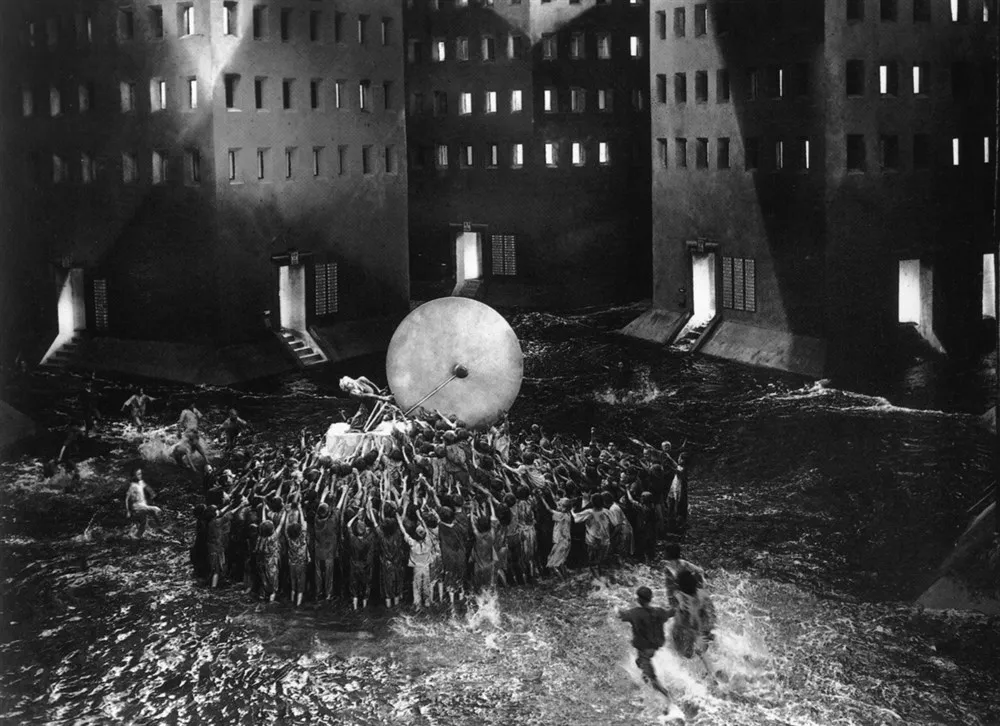
Metropolis, 1927. Freder, the son of the man who runs the city, has never been below ground. He wanders down and finds the machine halls: enormous engines and rows of workers moving in lockstep, their bodies bent into the shapes the machines require. One man at a pressure gauge can't keep up. The needle climbs, the machine overheats, and it explodes.
In the smoke Freder sees the machine change. It becomes Moloch, an ancient god with a gaping mouth, and the workers march up the steps into it in a line, fed to the machine so the city above can keep glittering. Then the vision clears, and it's just the machine again, and men are carrying out the bodies.
Fritz Lang made this as a silent film, almost a century ago, and he already understood what this essay is about: the prosperity above ground is produced by an industrial system below it, and the system has an appetite. Every factory does. The Machine Age's data halls, transformers, and cooling loops are Lang's machine halls with the sound turned on.
Here's what the film gets right that our conversation mostly misses. Lang's city isn't broken because it has machines. It's broken because the people upstairs never have to see what the machines consume. Freder's whole story begins with walking downstairs. Most of us will never stand inside a data hall or next to a transformer; the appetite of this machine age is designed to be invisible, piped through cloud regions and API calls. The film ends on the idea that the mediator between the head and the hands must be the heart. My plainer version: the people building the machine have to go downstairs. Know what it eats, who feeds it, and who lives next to it.
References
1 Wood Mackenzie, June 27, 2024, reported average US power-transformer and generator step-up transformer lead times of about 150 weeks over the preceding two quarters. Transformer market analysis.
2 Satya Nadella on BG2, October 31, 2025, as reported by Data Center Dynamics, November 3, 2025.
3 Stanford HAI, 2025 AI Index: The State of AI in 10 Charts. The comparison uses GPT-3.5-level performance on MMLU: about $20 per million tokens in November 2022 to $0.07 in October 2024.
4 International Energy Agency, Energy and AI: Energy demand from AI, 2025. Figures refer to total data-centre electricity consumption; the 2035 pathways reflect differing adoption, efficiency, and supply constraints.
5 SK hynix, Third-quarter 2025 financial results, October 29, 2025. Secured customer demand for planned production is not the same as guaranteed completed sales.
6 Google DeepMind, AlphaEvolve: A Gemini-powered coding agent for designing advanced algorithms, May 14, 2025. Performance improvements are company-reported.
7 The Henry Ford, Model T assembly-line history.
8 Tesla, Q1 2018 shareholder update, on treating the factory as a product and building the machine that builds the machine.
9 Chamath Palihapitiya, Making A Machine That Builds Machines, February 24, 2026. The essay also promotes his company's Software Factory product.